Monday, January 30, 2012

MiniBlog January 2012 - Snow!

Yesterday we had the prettiest snow storm! Big fat fluffy flakes fell slowly over the course of the afternoon. It emphasized how important it is to have structure in the garden - both hardscaping and plant material - because for at least 5 months of the year, my area is covered in snow.

Here are the Pussywillows in the backyard


The Magnolia and Deutzia bush


The Pin Oak, stone bench and obelisk


The Bench, Linden tree, junipers and Viburnum 'Mariesii'


The arbour, ornamental grass and rugosa roses


Sedum 'Autumn Joy'


The horizontal branches of Viburnum plicatum var. tomentosum 'Mariesii'


Spruce trees and our Serviceberry


The grasses in the front yard


Miscanthus sinensis


I sure do love the snow (as long as I don't have to DRIVE in it!! :)


Thursday, January 19, 2012

Diary January 2012 - Planning a Garden Part 1

Happy New Year!
Hope this year brings you health, happiness and much fun in the garden :)
January in Ontario can be cold, rainy, snowy, freezing, uncharacteristically warm, windy and/or blizzard-y. These changes sometimes take place within the space of a week!! (Weird, it was never like this when I was a kid!) Anyway, what January is NOT is a good month to be out in the garden
But January is a terrific month for planning.
Planning should be an essential part of your garden design. I know it's much more fun to choose seeds from catalogues and pretty plants at the nursery but you can waste a lot of time, energy and money by not planning ahead.
I have decided to split the topic of planning a garden into 2 parts: this month I will give you tips on how to design a brand new garden and next month we'll figure out how to change or fix up an existing garden.
Let's say you have bought a house with little or no landscaping at all.
Where do you start?
One of the easiest but most expensive ways is to hire a Landscape Architect or Garden Designer to plan your yard. Most companies will do both hardscaping ( which refers to any part of the garden that is non-living) like walkways, patios, decks, garden sheds, cabanas, arbours, walls and fences as well as softscaping (plants) including trees, shrubs and flowers.
If you would like to save some money and have the satisfaction of doing it yourself, you must still ask yourself many of the questions Designers would ask:
How do you plan on using the garden? Will it be a practical space to play or should it just look pretty? Is it important that it acts as an "outside room"?


Will you need a deck or patio? Do you like to eat outside or entertain outdoors?


Do you have children or grandchildren who will want space to play? What about a pet - will the dog need an area to run? Would you like a swimming pool?


Gardeners in the north ( in areas that experience 4 seasons) should consider garden elements that will look good in winter as well as spring, summer and autumn.


What's the exposure in your garden? Is it sunny all day long or are there large trees that provide a lot of shade? Are there strong prevailing winds that can damage sensitive plants?


Do you like gardening? Will you be willing to devote a few hours (or a lot of hours) to working in the garden? Planting is the easy part - the work comes when the garden must be maintained.

I guess what I am trying to emphasize is analyze your situation. If you can do that, you will create a yard that fits your needs.

So you've decided that you would like a patio or deck with pleasantly planted borders around the edges.
OK - good start. You can either hire someone to build the patio or do it yourself.
But what about the borders? Should you look at gardening books or magazines or internet sites and choose your favourites?
Ideas of what others have done are a terrific start but remember to personalize them into your own situation. Planting sun-loving shrubs and perennials in a yard that gets shade most of the day will kill those plants.


And should you just do softscaping? I would not recommend it.
If you think of the hardscaping as The Bones of the garden, then I recommend that you invest in the best Bones you can afford - the fences, the paving and the structures.
Make sure each bed that you plan has a pleasing shape and think of the hard elements first. Perhaps an arbour or an obelisk.


A bird bath or sculpture.


Boulders, river rock or rock walls.


Attractive garden sheds or play houses.


Quality structures remain beautiful as they age.

Once the Bones have been decided upon and placed, you can start thinking about the beds.
I would recommend deciding in this order: trees - deciduous and evergreen; shrubs; grasses; perennials and annuals.
I used to plan borders using graph paper, pencil and really good eraser!! Now it is more popular to plan online but either method works.
Measure the space you have (or estimate) and then plan in the plants that would do well together in your yard's environment and space.
Remember - PLANTS GROW!!! I know that sounds ridiculous to say but honestly, the number of people I hear complaining that such and such a shrub or evergreen is 8x the size that they planted it - I feel like saying: did you think it wouldn't GROW???
So when drawing in blobs to represent trees, shrubs and even perennials, always check their mature spread as well as their height.
Look how a border can fill in and "spread".


So I will leave you with this summary of ideas when planning a garden:
1. Decide what is most important for you in your yard
2. Invest in excellent quality hardscape
3. Include hard elements into borders
4. Think trees, shrubs, grasses, perennials and annuals, in that order.

If you plan a garden well, the outcome should be very satisfying and pleasing.


Friday, November 11, 2011

Diary November 2011 - No snow (here) yet!!


When you're young, you can't wait to get older, to start University or earning money, to be independent and to live your own "adult" life - it seems as if time moves ever so slowly!! When you're older, you want time to slow down but it just seems to fly! Unbelievable that it's November already and that it's only a month and a half till Christmas. Wow.
November is not a popular month - November is when we turn back the clocks and it's dark at 4 pm already. Some days it's cold and nasty and damp and windy. It's not winter yet but you can feel it coming!
But the bonus days are when November forgets it's supposed to be cold and nasty and we get a gorgeous, sunny day that's warm and feels like early September.
We've had a few of those lately and I've tried to get out in the garden as often as possible, still trying to put it "to bed".
The other day I was out and saw some real photo ops so I ran inside to get my camera and here's what I saw.
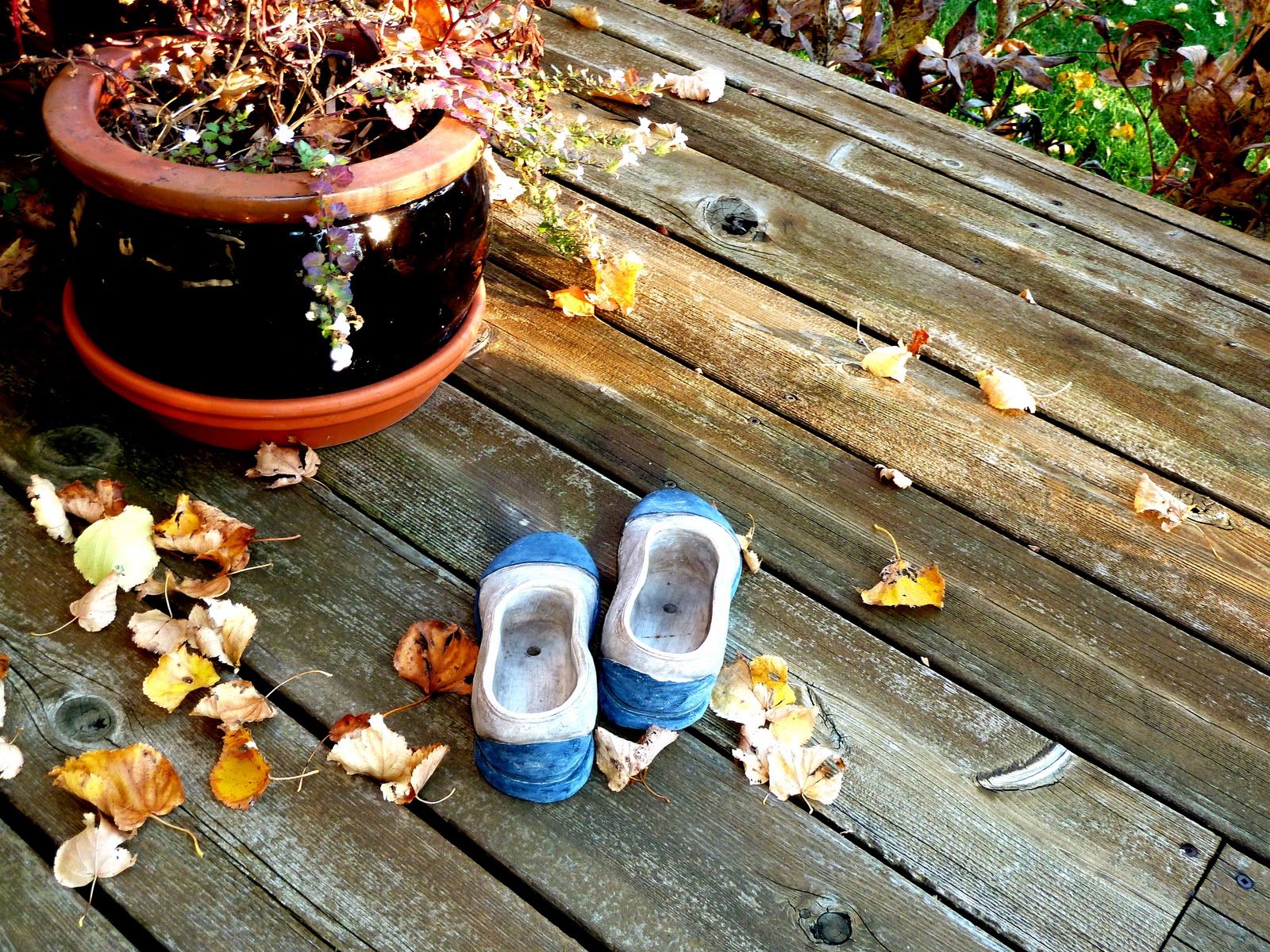
(Above) My deck is alternately covered with leaves or the wind has blown every leaf off. Here are my cute ceramic "flower pot" shoes beside a container that needs to be put away for winter. The lovely yellow leaves blew into a composition that a stylist would love!

I cut down the front garden and replaced the frozen, dead, soggy coleus with evergreens from the backyard. It's great to get the branches into the soil while it's still soft and moist. The branches freeze into the soil and make the urns heavy and solid. Strong winds can't knock them down. I used yew, green and blue spruce as well as a few red dogwood branches. Then in early December I just have to add my Christmas balls and decorations and voila! The urns are festive and ready!


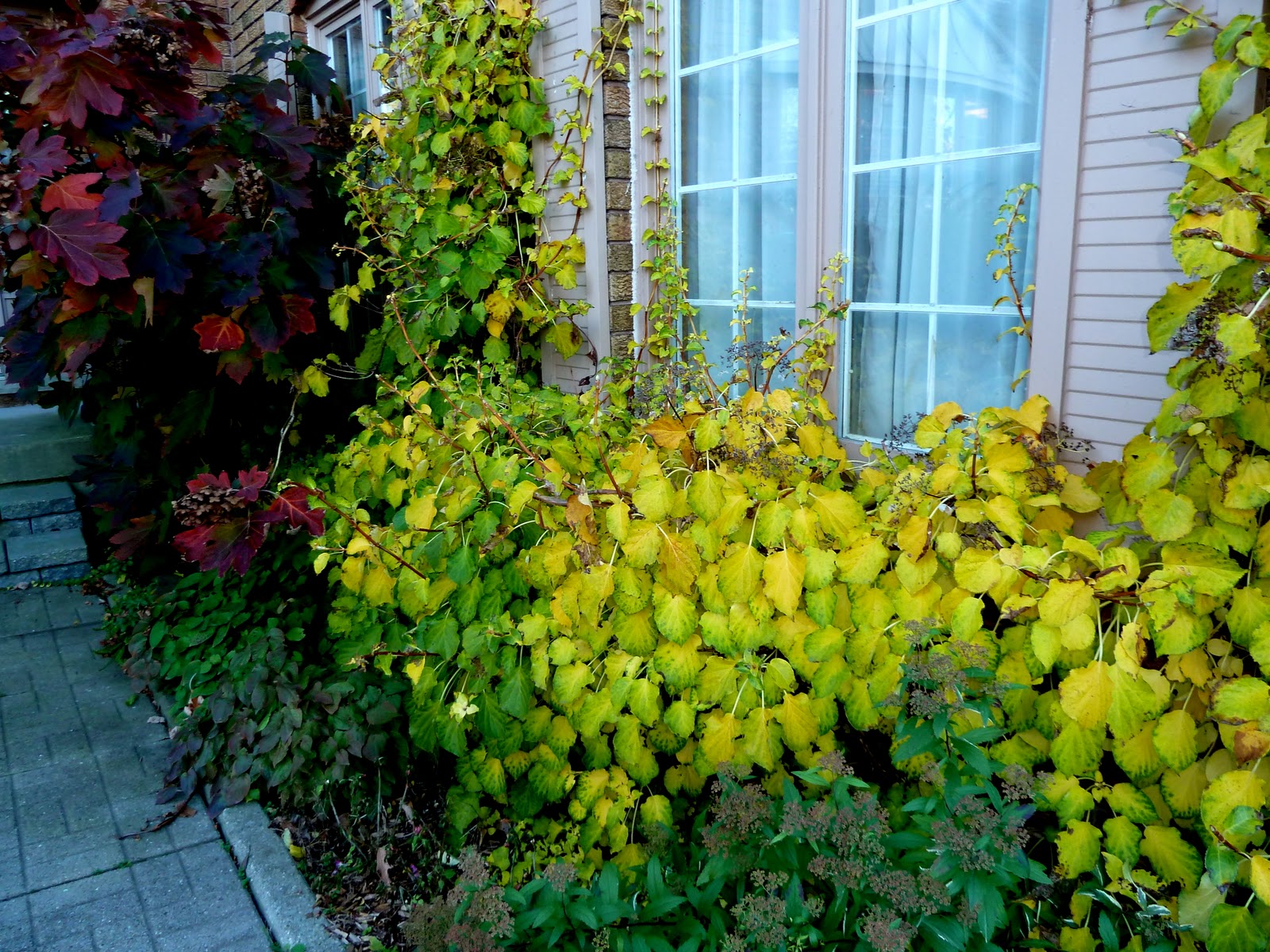
I can't stop singing the praises of having an Oakleaf hydrangea (and I guess I can't stop photographing it either!!)
It is one of my all time favourites because of its 4 season beauty: leaves that unfold in an interesting way in spring, gorgeous dark green leaves with white conical blooms in summer, bronze flower clusters and fabulous multi-shade red leaves in fall and peeling bark as a winter interest.


The leaves on the climbing hydrangea vine (that grows beside the Oakleaf Hydrangea) turn yellow and sometimes fall off all in one day and night!


The hostas have all turned yellow and gone soft


My 4 Burning Bushes are really weird this year: one died, one is bright red and beautiful, one is slowly turning red and one is still completely green!!???


When I bought this statue years ago in Doon, the name attached to it was "Elaine" so I have always called this my Elaine Bed. And this is how I like my garden beds to look for winter - clean and clear with no debris harbouring pests.


You have to search for beauty in the late autumn garden but it's there:

Bergenia cordifolia:


Monkshood (Aconitum)


Rose hips


and Black Eyed Susans (Rudbeckia) with just their little black eyes left!


Be sure to look for those last beautiful garden touches in your own garden or elsewhere. They're still out there - you just have to search carefully.
BTW - I cut and trimmed 35 geranium stems and will attempt to grow next year's geraniums from cuttings. I'll let you know if I'm successful!

Tuesday, October 18, 2011

Diary October 2011 - Autumn


I started this blog in 2005 because I wanted to design my "retirement garden".  Who would have thought that Retirement which had seemed sooooooo very far down the road would be here this quickly? But - here I am. Retired!!!
I don't plan to re-design anything just yet nor do we plan to downsize, so instead I will continue to take care of the huge garden I have now and give you any tips that I learn along the way.
I have already been out in the garden numerous hours and really enjoyed myself. But my goodness! You can tell I designed this garden 23 years ago - I had a lot more energy then and no mobility problems.
Well - things are different now but I hope to be able to do a bit every day instead of trying to squash everything into Saturdays and Sundays. It should make planting and weeding much more enjoyable.
The 2 main things I needed to do before the snows fly were (a) plant my new spring bulbs and (b) cut down the perennials.
Before I do a Show and Tell of what daffodils and tulips I planted, let me give you a few tips of what to do and what NOT to do in the fall in the garden.
1. Plant spring bulbs as long as the ground is still soft and workable (ideal month is September)
2. Rake leaves off the lawn and put them into the compost heap or into paper Yard Waste bags and have them taken away.
3. Pull out annuals and if not diseased, put in compost. If diseased, throw them away.
4. Cut perennials to the ground to prevent hibernation of pesky bugs. DO NOT cut roses to the ground (check google for proper procedures. I could devote a whole column to rose care alone)
5. Cut grasses down or not, but be aware that as the winter comes on, they will dry out and start blowing around the yard
6. Dig out any weeds and dispose of them. This will give you great head start in the spring.
7. Lightly mulch beds and any fragile plants you have
8. As a rule, do not cut back shrubs until spring or summer, depending on when they bloom
9. Do not fertilize anything in the fall
10. Water heavily if it's a dry fall. If there's plenty of rain, you'll be OK. Water under the eaves and under trees, though, and any other areas that seem dry.
11. Bring your clay pots into the shed or garage or they will split and crack over the winter and spring.

There's lots more advice I could give you (you can look up more on the Internet) but that should be enough to keep your garden clean, healthy and attractive over winter.

OK - now the fun part!!! Look what I bought and planted early this month!

Tulips first (I don't plant as many as I used to because they are a squirrel's gourmet lunch) but there are some I just can't live without.

Apeldoorn:


Blushing Girl:


Flaming Parrot (I would have preferred Estella Rynfeld, but I couldn't find any!)


Queen of the Night


Small, early 12" Red Riding Hood tulips (let's hope the rabbits don't chew them up in the spring)


Dwarf Iris "Harmony"


And then a whole slew of Daffodils or Narcissus:

Mount Hood


Tahiti


King Alfred


Ice Follies


February Gold


Suzy


Jetfire


Thalia


and Hawera


They range in height from 8" (dainty Hawera) to 16" Suzy and King Alfred. I love Thalia because it's so fragrant and Tahiti because it looks exotic.
Squirrels and other critters love tulips but find daffodils, crocus and other small bulbs bitter so they leave them alone. Another reason to plant more daffodils than tulips is that they multiply into clumps and get bigger over the years. The new hybridized tulips often have no fragrance and "peter out" after 4-5 years. (only leaves come up in yr 4 or 5 - no stalk and no flower). If you are lucky enough to have moved into an old home with an old garden, you may have the  "old" style tulips from the 60's and earlier. They are strong, fragrant and return year after year.
So here is our beautiful Ontario fall - lovely sunny warm days that may stay well into November. Then rotten old winter comes but by planting bulbs, you already have something to look forward to just a few months later!