Showing posts with label hosta. Show all posts

Monday, April 7, 2014

Problems affecting Impatiens


I recently found out that there are a number of very serious problems affecting the beloved shade-tolerant annual Impatiens. The 2 most serious are Downy Mildew and a virus called Impatiens Necrotic Spot Virus.

Impatiens Necrotic Spot Virus is not very well understood yet. It is believed to be caused by a small bug called a thrip (also called a thunderfly, storm bug, corn fly or corn lice). The thrip is a very tiny cigar-shaped insect with fringed wings.
The virus causes wilting, stem death, yellowing, poor flowering, sunken spots and/or ring spots on the leaves. But many times the plant dies without showing any symptoms at all.

Downy Mildew causes the same type of damage. Within several weeks of planting, a bout of humid or wet weather can cause perfectly healthy impatiens to suddenly lose all their flowers and leaves and be bare stalks overnight.

Many green houses in the USA have stopped growing and selling impatiens or at least have cut back by 75%.

Last summer this problem starting appearing more often in Canadian gardens.


This is a real shame. Impatiens have long been the most reliable colour annual for shady areas.

What now?

Well, no one is saying not to plant impatiens. The reports are just warning what could happen.
New Guinea Impatiens/Sunshine Impatiens do not succumb to this problem at all.

If you decide not to plant impatiens, here are some good alternatives:

Fibrous or wax begonias were my top performers last summer. Great for sun or shade.


Another wonderful substitute is Tuberous or Rex Begonia. These are gorgeous but quite a bit more expensive.


Coleus has made amazing strides these past years. They now come in a wide array of colours, textures and sizes. They perform best with a bit of shade or in full shade.


Caladium is an indoor plant but I have had much success with its gorgeous pink speckled leaves in shade containers.


Heuchera is another plant that has evolved a lot in the past years. It is a perennial, therefore will cost more up front, but it comes back year after year, so it will pay off in the long run. The reason I mention it as a replacement for impatiens is that it also comes in many multi-colours and stays lovely the whole summer.


Brunnera is another speckle leaf perennial that looks great all summer long.
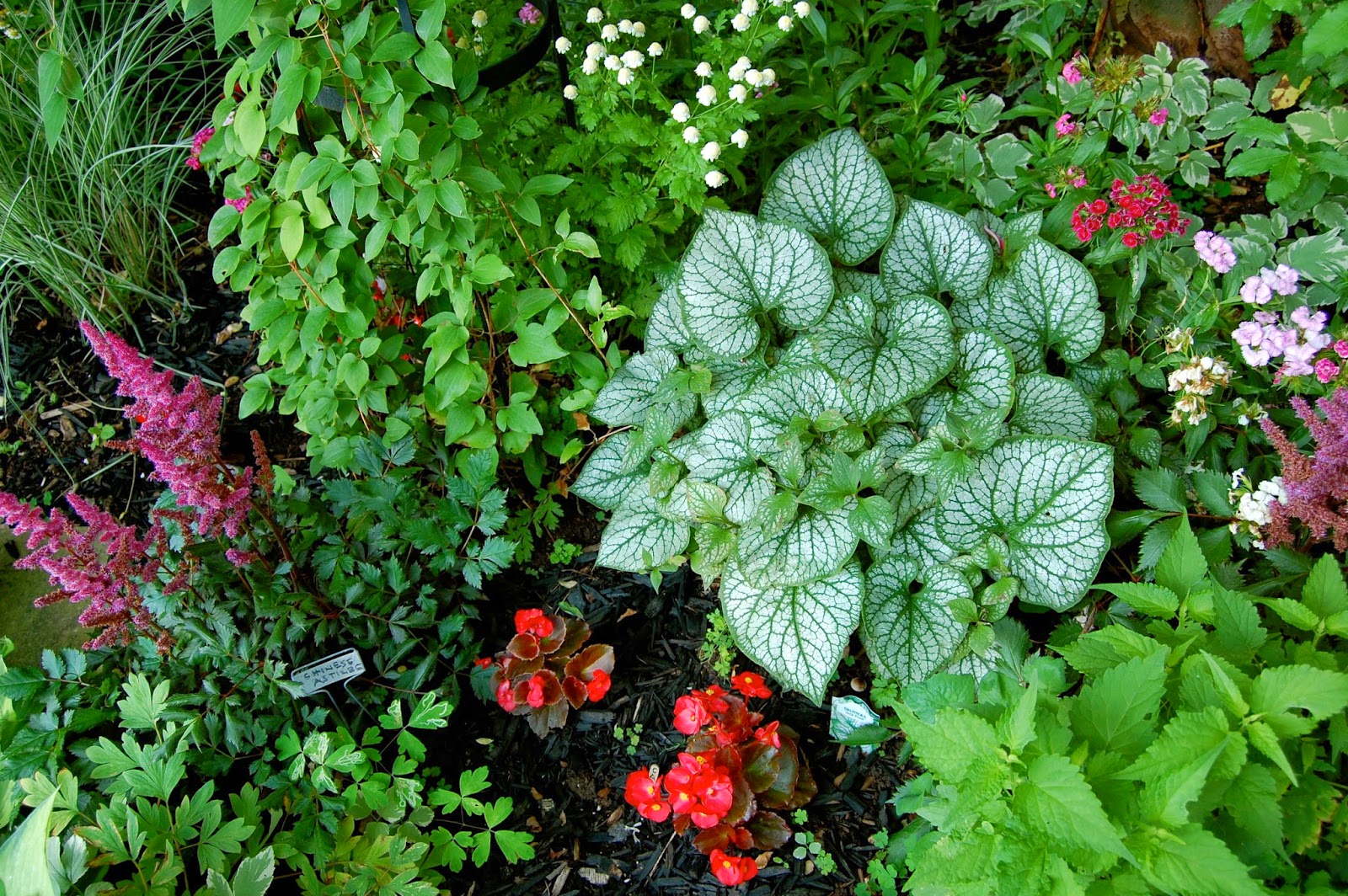

Variegated Hosta can also add punch to a summer border. Not as much colour as impatiens, but a strong choice to replace the poor little sickly standard.


Please check out my food blog - the latest post is Roasted Chicken Thighs with Potatoes.

Tuesday, March 25, 2014

Green in the Garden (last of the series)


It seems almost silly to talk about green in the garden. OF COURSE there's green in the garden - most leaves, stems and evergreen needles are green.

But if you look more closely, you'll notice that the green of spring is fresh and lime-coloured. Summer green is mature, deep and lush. Many green leaves turn a completely different colour altogether in fall.

Green makes shady places look cool and fresh. I'm lovin' all the different names too: pea, olive, fern, bean, lime, kiwi, mint and ivy.


Brunnera has small blue flowers in spring but the rest of the summer its variegated leaves are a stand-alone focal point.


Euonymus, Love-in-a-Mist and variegated Hosta show different shades of green as well as different textures.


Hostas and painted ferns


Lots of different shades here beside a calm, reflecting pool.


Silver-y blue/green of the nest spruce sets off the greens of hostas, ferns and shrubs


Green leaves spill over a patterned indigo wrought-iron fence


Such cool variegation!


I have always loved striped Miscanthus grass and have it many spots throughout the garden


Huge swaths of pachysandra surround a dogwood bush.


Look at the texture-mania happening here!


One of my autumn favourites: multi-coloured layered kale beside a big rock, surrounded by periwinkle, lamium and miscanthus.

Please check out my food blog - latest post is Very Crispy Oatmeal Raisin Cookies.

Friday, June 28, 2013

Bed 4


When we moved in to this house 25 years ago, I made a lot of perennial beds but had no hardscape structures or mature trees. Over the years we have renovated sections of the garden and of course the plants have matured and grown. I am pleased that each bed seems to have taken on its own personality lately. I have "names" for each bed so I know where I am planting what but even those have changed. Originally they were Beds 1, 2, 3, 4 and 5 whereas now they are nicknamed the Front, the Elaine bed, the Gnome bed, Bed 4, The Oak tree bed and the Vortex bed. (!!)
Bed 4 is halfway down the southwest side of the yard beside the pool pump. It's the only one that has retained its original name. Certain plants such as the spruce tree and the shrub rose have exploded in size. Many of the perennials are the originals, others are new. But there is great camaraderie among them so I thought I would show these successful combinations to you.


I have attempted to keep the gentle curved shape by edging sharply in the spring. I actually need to carve it out wider under the spruce because it's so hard to mow the grass under there. The main large plants are (from right to left) a spruce tree that was brought as a sapling from Northern Ontario, a shrub rose that's gone berserk this year in size, a graceful weeping Norway Spruce that still retains its elegant shape, a very ordinary do-nothing Rose of Sharon ( but it was a gift so I keep it) and a common lilac shrub, that bloomed its head off this spring!


The lilac in bloom


A close-up of the Weeping Norway Spruce


In the spring came a lovely group of bright red Darwin tulips. The stone fish wasn't yet being smothered by the Coreopsis 'Moonbeam' so it's still deeper in. I had already planted 3 of the succulents: Sedum and Sempervivum.


When the tulips and muscari faded, in came the Siberian Iris and small yellow Allium moly.


As the Hosta emerged ( 3 clumps of Blue Wedgewood and a transplanted chunk of 'Great Expectations') and the Coreopsis 'Moonbeam' filled out, I moved the Fish to a more prominent position. I also bought several more drought tolerant plants. They are now starting to bloom.


This is a new one that caught my eye: Sempervivum x hybrid 'Commander Hay'. It was big, interesting and cheap. I bought 3 in total. Extremely drought tolerant once established. They are easy to propagate - just remove the small baby rosettes and replant in a new location.


I thought this neon yellow sedum would fit nicely with a bed that is mostly green, stone blue and fall hues. This is Sedum rupestre (reflexum) 'Angelina'. It has a long, lanky habit.


Once I became totally enamoured with these succulents, I just ran right out and bought another one! Above is Sempervivum arachnoideum - Spider Web Hens and Chicks. Before it started to bloom, the rosettes seemed to be covered in spiderwebs.

Here are a few more shots of how well they blend together.


The daylilies are ready to bloom and the huge shrub rose will start to develop hips.


Helianthus are starting to bloom and in August the Red and Gold Fall Helenium will emerge (new this year).


Bed 4 has turned into a great 4 seasons show that has unusual plants that somehow co-exist well and even show each other off really brilliantly.

Please check my food blog - the latest recipe posted is Spinach Cavatappi Gratin.


Saturday, March 16, 2013

Good Old Reliable Hostas


Hostas, also known as plantain lilies, are steadfast garden staples because of their beautiful foliage and sometimes, because of their fragrant flowers.
Hostas thrive in the shade but many can tolerate a bit of sun. There are many, many types as well as many sizes. The tiniest ones are called miniatures. The largest can grow over 6' wide!
Reading up on them, I didn't realize that I actually have (or had) a number of Hostas that have gained the Royal Horticulture Society's Award of Garden Merit! I have (Tardiana group) 'June', H. sieboldiana 'Frances Williams', 'Golden Tiara' and 'Krossa Regal'.
Hosta leaves, although beautiful, can be an open invitation as lunch for snails and slugs. I have found slug bait and other slug deterrents to be moderately successful. I heard that the best way to get rid of snails and slugs is to get up very early in the morning, to hand-pick them off and drop them into soapy water. You know? I'll get up early to catch a plane for a vacation but darned if I'm giving up my precious sleep for slugs :)
Slugs and snails don't (can't) eat through thick-leaved Hostas so that in itself is a deterrent. For late risers like me, maybe those our best bet.
One of the best sites for Hosta identification is Hosta Library. It identifies hundreds of varieties by name and photo.

Here is 'Blue Wedgewood' with perennial geranium, Painted Japanese fern, phlox, junipers and impatiens. It grows to about 14" high and 24" wide.


Another shot of 'Blue Wedgewood' beside my Weeping Norway Spruce. Great textural contrast!


This is 'Sagae'. It's big but has never reached the projected size of 31" high x 70" wide.


The prominent hostas here are 'Elegans' (foreground) and 'Paul's Glory' behind it. I used to have 'June' but I don't think that's 'June' at the right…(which should be variegated….I think it died out)


Here is one of the Garden Merit Award winners: 'Krossa Regal' beside Euonymus 'Gaity'


Elaine is surrounded by 'Golden Tiara' and columbines!


Look carefully along the pathway and you'll see variegated "Night Before Christmas'


'Frances Williams' among periwinkle, euonymus and Sweet Williams


One of the tiny miniatures 'Pandora's Box'. I shot this while on a garden tour so I don't know the names of the surrounding Hostas.


Here's my friend Sheila's 'Praying Hands' Hosta


Hostas make great border plants!


Hostas blend so beautifully with all other plants. As my garden has become more and more shady over the years, I appreciate them very much.


Check out recipes for New York Style Cheesecake and Mushroom and Leek Soup on my food/recipe blog:
Astrid's Home